Fast start. Progressive difficulty. High replay. Low setup.
At 8-10 years of age, most kids are not limited by intelligence. They are limited by thinking stamina, which is the ability to hold a problem in mind, try a second approach when the first fails, and stay calm long enough to finish the loop.
That is not a “math” skill or a “smart kid” trait. It is a transferable skill cluster that quietly touches everything else your child will do.
And it matters because the next few years will reward the kids who can think in systems, hold attention under friction, and adapt when the rules change. The World Economic Forum keeps pointing in the same direction: employers are hiring less for narrow routines and more for problem-solving, analytical thinking, creativity, and resilience. The OECD makes a similar point through its breadth of skills lens: future readiness is not only literacy and numeracy, but also the wider skills that help a child learn faster, think clearer, collaborate, and recover when they are wrong. That is why logic and puzzle games are not a cute extra. They are a practical training ground for foundations that show up later in harder exams, grad school intensity, and real work where nobody tells you the steps.
This is also why ages 8–10 are a sweet spot. Kids can finally handle real constraints such as rules, sequences, and multi-step planning, but they are still young enough that habits form quickly. Logic and puzzle games do this cleanly because they create the right kind of friction without turning your home into a classroom.
Here is what these games build when they are chosen well:
- Working memory: hold steps in mind without losing the thread
- Spatial reasoning: rotate, map, visualize, plan
- Inhibitory control: slow down, resist impulse, follow rules
- Problem decomposition: break one big task into smaller decisions
- Recovery: mistake → reset → try again without drama
How this shortlist was chosen
Every pick below meets at least three of these filters:
- Fast start: you can begin in under 2 minutes.
- Progressive difficulty: the challenge ramps without you inventing “levels.”
- Replay value: the game stays alive after week one.
- Low setup: minimal pieces, minimal prep, minimal cleanup.
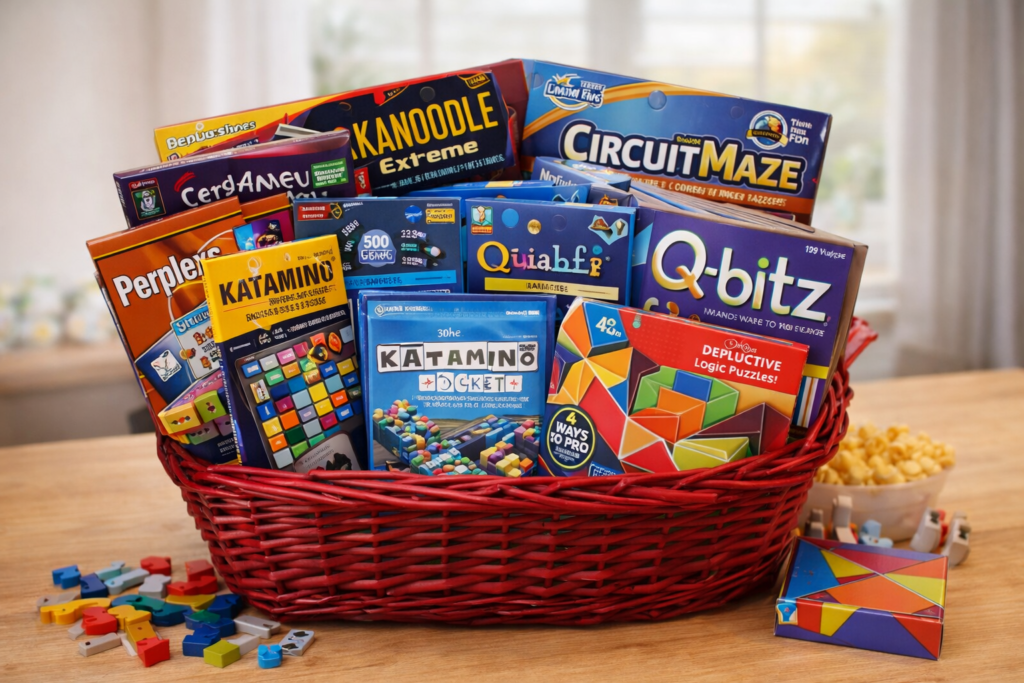
The shortlist (12 that actually match the criteria)
- Kanoodle Extreme (Educational Insights)
Over 300 portable challenges with a tight learning curve. Great when you want repetition without boredom.
Trains: spatial reasoning, planning, persistence under time. - Katamino Pocket (Gigamic)
A compact pentomino-style puzzle with 500 challenges that quietly forces real problem decomposition.
Trains: spatial structuring, flexible thinking, error correction. - IQ Six Pro (SmartGames)
A travel-case logic puzzle with 120 challenges across 2D and 3D patterns.
Trains: spatial insight, sustained attention, disciplined trial-and-adjust. - The Genius Square (Mukikim)
Dice generate the constraints, so you get a huge replay loop with 62,208 possible setups.
Trains: fast planning, constraint solving, adaptability when blocked. - The Genius Star (Mukikim)
The harder sibling of Genius Square, with 165,888 possible puzzle setups and a strong competitive “race” mode.
Trains: advanced spatial reasoning, speed under control, composure under pressure. - Circuit Maze (ThinkFun)
A circuit-building logic game with 60 challenges that teaches sequencing through real cause-and-effect.
Trains: sequential reasoning, planning, systems thinking. - Roller Coaster Challenge (ThinkFun)
A build-the-track puzzle with 40 challenges that pushes visualization and constraint logic.
Trains: spatial planning, iterative design, patience. - Q-bitz (MindWare)
A pattern-building race where rounds shift from speed to memory, using 80 challenge cards and three play modes.
Trains: visual processing speed, working memory, accuracy under time. - Perplexors Level A (MindWare)
This is the sleeper weapon. Pure logic-grid deduction, no flashy pieces, just clean reasoning and elimination.
Trains: deduction, attention to detail, structured reasoning. - Tangram-style set (wood or magnetic)
It looks basic, but it is a serious spatial trainer if you use progressive cards/patterns.
Trains: rotation, part-whole thinking, mental imagery. - A quality 3×3 speed cube (Always combine this with a beginner method guide)
It is not just a toy. It is algorithmic thinking plus frustration tolerance in physical form.
Trains: sequencing, working memory, calm repetition. - A compact “constraint puzzle” pack (metal disentanglement or knot puzzles, age-appropriate)
Not everyone loves these, but the right kid becomes obsessed. Great for persistence and focus, terrible for kids who need novelty every 20 seconds.
Trains: patience, tactile problem solving, staying power.
A simple 2-week progression plan (works with 1–2 games)
Days 1–3: Make it embarrassingly easy
Pick the easiest challenges. Stop while your child still feels capable. Your goal is not difficulty, it is habit.
Days 4–7: Add one constraint
One of these: a timer, fewer hints, or “two tries before asking for help.” Keep the tone calm. No coaching speeches.
Days 8–10: Teach the reset
Introduce a rule: when you get stuck, you must try one different approach before quitting. This is where progress actually compounds.
Days 11–14: Increase difficulty, not duration
Do harder challenges, not longer sessions. Ten minutes of hard thinking beats forty minutes of drifting.
The parent move that matters most: praise the middle.
Not “You’re smart.” Instead: “You stayed with it when it got annoying.” That is the skill you are buying these games to train.