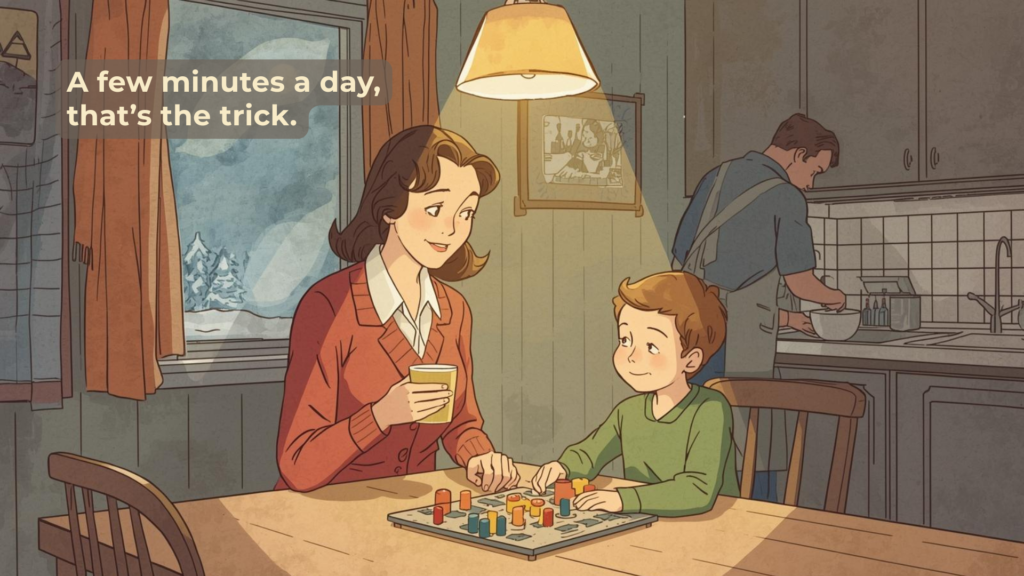
There is a strange thing happening in our homes.
It happens in ordinary moments. You’re in the kitchen, your child is half distracted, and a question comes up about the weather, money, a news headline, anything. They give you a clean line they’ve heard somewhere. It sounds right. But when you gently ask, “Why?” or “How do you know?” the explanation doesn’t arrive.
Now it should not be considered a failure of intelligence. It’s actually the difference between information that passes through, and knowledge that settles within one person.
Information can feel like knowing. But knowledge is something else. Knowledge is what stays with you when the screen is off. Knowledge is what you can hold in your own mind, connect to other ideas, and use when life asks you a new question.
Information is like ingredients placed on the counter. Knowledge is the meal.
Information is like scattered bricks. Knowledge is a house.
A child can repeat: “Inflation is rising prices.” That is information.
But knowledge is being able to say: Why do prices rise? What could slow it down? What changes for families when it happens? That is understanding. That is the part that becomes wisdom later: sensemaking, synthesis, judgment.
And the gap between these two is growing.
Why the gap keeps widening
Search and AI are not evil. They are tools. But tools train habits.
When answers arrive too quickly, the first thing that disappears is the first thirty seconds of thinking. The small struggle that forces the mind to make its own map. The uncertainty that teaches a child to sit with a question long enough to shape it.
So our children are becoming excellent at retrieving from outside.
And slowly, without anyone noticing, weaker at building from inside.
The goal at home is simple:
Move your child from “I know it” to “I understand it.”
Three patterns to watch for
1) The copy-and-say problem
They can repeat the explanation, but they cannot rephrase it in their own words. If you ask them to explain it to a younger sibling, it falls apart.
2) The search-first reflex
They reach for the device before they try. Not because they are bad. Because they have learned: why wrestle with a question when the answer is two taps away?
3) Confidence without proof
They believe what sounds clean and certain. If something is said strongly, it feels true. This is not only a child problem. Adults fall for this every day.
Three gentle habits that convert information into knowledge
1) Delay the search by 60 seconds
Before any screen opens, ask:
“What do you already know?”
“What exactly is the question?”
This one minute trains independence. It teaches the mind: I can begin.
2) Make one simple model
One sentence, plus one structure. A timeline. A cause-and-effect chain. A trade-off. A quick map of “this leads to that.” It doesn’t need to be pretty. It needs to be clear.
3) Do a calm credibility check
Not paranoia. Just routine:
Who is saying this? What evidence do they show? What would a second source say?
This is how you teach your child to respect truth without fear.
Ten games that train knowledge-building (not trivia)
All of these are widely available on Amazon. Use them the same way: 15–25 minutes, then a 60-second debrief: What did we assume? What changed our mind? What was the real structure?
- LAMBOOZLED! media literacy card game: evidence, context, and “real vs fake” reasoning.
- Paranormal Detectives board game: practice evaluating data and information calmly.
- Casefile: Truth & Deception: a deduction case where evidence can be traded and planted, so you learn to verify.
- Timeline (or Timeline Twist): turn scattered facts into chronology, and catch your own wrong assumptions.
- MicroMacro: Crime City: a giant map where you reconstruct events across time and space.
- Concept: communicate ideas using icons only, which forces distillation and clean meaning.
- Turing Machine: hypothesis-testing against an “analog computer,” built for disciplined verification.
- Cryptid: deduction from partial clues, where one sloppy assumption ruins the whole search.
- Deduckto (Gamewright): fast deduction with clear elimination, perfect for 11–12 attention spans.
- The Search for Planet X: deeper science-style deduction for strong readers who like longer games (great stretch at 12).
The internet is not the enemy. The enemy is the belief that access equals understanding.
Information is cheap. Understanding is rare. Train your child for the rare part.