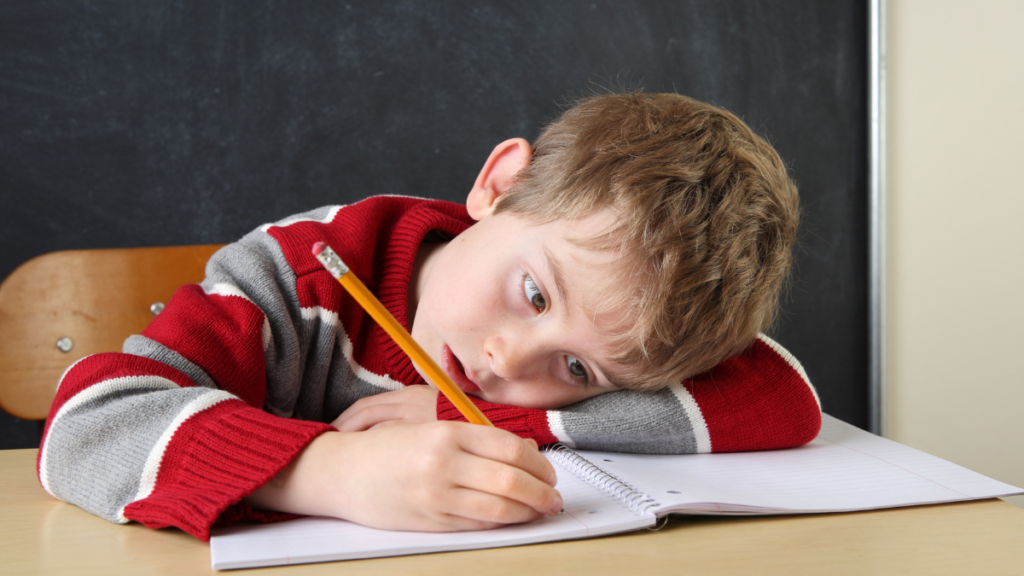
If your child can do the math but collapses the moment it shows up inside a paragraph, you are not imagining it. Plenty of kids can add, subtract, multiply, and divide, yet look completely lost when the question arrives dressed up as a story.
Parents usually respond in one of two ways. They either explain more or they tell the child to read it again. Not saying that both methods do not work, but neither addresses the real reason word problems feel like a wall.
The reason here is simple: The word problems are not “math problems” first. They are first, translation problems.
Let’s learn from Singapore
Singapore gets referenced so often because this is not a one-off success story. In global comparisons like TIMSS 2023, Singapore ranked #1 in Grade 4 mathematics (average score 615) and also #1 in Grade 4 science. More importantly, this is consistent: across the last four TIMSS cycles, from 2011 to 2023, Singapore has ranked #1 in Grade 4 maths every time.
That does not mean parents should copy an entire education system. It does mean this: when a country repeatedly performs at the top, it is worth asking what they are doing differently at the level of methods, not pressure.
And one of the most useful methods Singapore popularized for primary learners is simple, practical, and very relevant to the “word problem panic” parents see at home.
The real bottleneck: kids do not know how to represent the story
Most children approach word problems like this:
- scan for numbers
- hunt for keywords (“more,” “left,” “each”)
- guess the operation
- hope they are right
This works until problems become slightly more layered, or until the wording becomes unfamiliar. Then the child is stuck with a foggy feeling: “I do not even know what this is asking.”
That feeling is not a sign that the child is weak in math. It is a sign they are missing a skill that schools rarely name clearly: representation.
Representation means turning words into structure. It means being able to say, “This story is really a comparison,” or “This story is really parts making a whole,” and then showing it in a simple form.
What Singapore does differently: model first, math second
Singapore-style instruction often uses what is widely known as the model method or bar modelling. The logic is straightforward: instead of jumping straight to operations, students first draw a simple model (often using bars or boxes) that shows the relationship between quantities.
This is not about drawing pretty pictures. It is about making the relationship visible.
When the relationship becomes visible, the operation stops being a guess. It becomes the next obvious step.
The technique (parent-friendly, not tutoring-heavy)
You only need three moves. If you do them consistently, your child starts learning the missing middle step that turns word problems from panic into process.
Step 1: Strip the story down to what matters
Ask your child to do two things:
- Circle the question (what exactly are we trying to find?)
- Underline only the numbers that change the answer
Anything else is decoration. Word problems often contain extra words that feel important but are not.
Step 2: Draw the relationship, not the scene
This is the main move.
Instead of drawing a person, birds, apples, trains, or whatever the story includes, your child draws a bar model that shows one of these relationships:
- Parts make a whole
- One amount is compared to another
- Something increases or decreases over time
If your child draws a messy bar with labels and arrows, that is fine. The goal is clarity, not art.
Step 3: Choose the operation last
Only after the relationship is drawn should your child decide which operation to use.
This flips the usual approach. Most kids choose the operation first and then try to force the story to match it. That is where the confusion begins.
Three examples that make this click quickly
Example 1: Parts make a whole
“Sara has 12 stickers. Ali has 9 stickers. How many stickers do they have altogether?”
Model: two bars side by side labeled 12 and 9, then a bracket showing the total.
Once the model is drawn, the operation is obvious.
Sara: [—— 12 ——]
Ali: [—- 9 —-]
Altogether:
[—— 12 ——][—- 9 —-]
<——– total = ? ———>
Example 2: Comparison
“A has 18 marbles. B has 11 marbles. How many more marbles does A have than B?”
Model: draw two bars aligned at the start, one longer (18), one shorter (11). The extra part of the longer bar is the answer.
This is why modelling reduces panic. The child can literally see what “more than” means.
A: [—— 11 ——][— ? —]
B: [—— 11 ——]
Example 3: Change over time
“There were 14 birds on a tree. 6 flew away. How many are left?”
Model: one bar for 14, then a segment removed for 6, leaving an unknown remainder.
Again, the operation becomes a natural consequence of the drawing.
If your child struggles with word problems, do these three types repeatedly before moving to harder ones. Most children freeze because they have no structure. Once they have structure, complexity becomes manageable.
Start: [—- ? —-][– 6 –]
Total: <——– 14 ——–>
Why this is bigger than math
This is the part parents should not miss.
Representation is a life skill. It is the ability to take something messy, verbal, confusing, and turn it into something workable. That shows up everywhere:
- reading comprehension
- exam performance under time pressure
- science questions that hide the real relationship inside text
- decision-making in everyday life
In other words, you are not only helping your child solve word problems. You are helping them learn how to think clearly when information arrives as noise.
What to stop doing (because it quietly backfires)
- Stop rushing to tell the child which operation to use.
- Stop treating “read it again” as the main strategy.
- Stop rewarding speed when the child is not yet clear.
Your new rule is simple: model first, math second.
Use the following tools to work on these models:
If you want to support this skill without turning your home into a tutoring center, choose tools that force the same thinking:
- Singapore-style bar modelling practice books or cards
- math story problem games that require explanation, not only answers
- logic and diagram puzzles that train representation without math anxiety
When your child freezes on a word problem, it is tempting to label it as a motivation problem or a math problem. Most of the time, it is a representation problem.
Singapore’s edge here is not magic and not pressure. It is the method. They train the missing middle step: turning stories into structure before touching calculations.
Give your child that step, and you will watch the panic shrink. Not because the problems got easier, but because your child finally learned how to make them make sense.
Singapore-style bar modelling practice books or cards
Ages 5–8 (roughly Grades 1–3)
- Problem Solved: Bar Model Math Grade 1 (Singapore method) (step-by-step lessons + word problems).
- Problem Solved: Bar Model Math Grade 2
- Problem Solved: Bar Model Math Grade 3
- Word Problems for Model Drawing Practice – Level 1 (Singapore-style model drawing practice).
- Challenging Word Problems (Singapore Math) Grade 2 (good if your child already does basic bar models and needs harder language).
Ages 9–11 (roughly Grades 4–5)
- Problem Solved: Bar Model Math Grade 4
- Problem Solved: Bar Model Math Grade 5
- 8-Step Model Drawing: Singapore’s Problem-Solving Math Strategies (great as a parent “how to teach the diagram” guide).
- Step by Step Model Drawing: Solving Word Problems the Singapore Way (another parent-friendly guide to the method).
- Singapore Math Challenging Word Problems (complete set) if you want a longer runway of difficulty.
2) Math story-problem games that require explanation, not only answers
You’re right to be picky here. Most “math games” train calculation speed. These are better for forcing kids to say what they are doing.
Ages 5–8
- Sum Swamp (Learning Resources): kids move through story-like prompts and do operations in context (easy, low-friction).
- Math Dice Jr (ThinkFun): quick prompts that naturally lead to “how did you make that number?” conversations.
- Tiny Polka Dot (Math For Love): not “word problems,” but fantastic for math talk (reasoning, comparisons, probability intuition).
Ages 9–11
- Equate: The Equation Thinking Game: Scrabble-style equations. Kids must justify placements and operations, not just compute.
- Prime Climb (Math For Love): strategy + number structure (factors/primes). It triggers explanation organically because moves have reasons.
3) Logic + diagram puzzles that train representation without math anxiety
These are your “stealth Singapore” tools: they build visual modelling, constraint thinking, and calm persistence.
Ages 5–8
- Rush Hour Jr (ThinkFun): pure representation + planning, no numbers, very Singapore-compatible for “model first.”
- Balance Beans (ThinkFun): early algebra/logic balance thinking through a visual model.
- Kanoodle (Educational Insights): spatial representation, rotation, constraint solving.
- SmartGames IQ Puzzler Pro: compact “set up the model, then solve” puzzles; strong for ages 6+.
Ages 9–11
- Gravity Maze (ThinkFun): build-the-model first, then test; great bridge from diagram to outcome.
- Chocolate Fix (ThinkFun): logic grid reasoning in a story wrapper; forces structured inference.
- SmartGames IQ Puzzler Pro also stays relevant here as difficulty increases.