Most parents grew up with a simple promise: study hard, pick a respected profession, and life will take care of itself.
That promise is getting shaky. Not because education has become useless, but because the world of work is changing faster than the world of schooling, and technology is changing faster than both.
The signal is no longer subtle. In the World Economic Forum’s latest survey of employers, a large majority expect AI and information-processing technologies to transform their business by 2030. Executives also cite “lack of skills” as the biggest barrier to making that shift. That is not just a technology story. It is a readiness story. Even the organizations building the future are not fully confident people are prepared for it.
The OECD lands in a similar place from a different direction. Historically, new technology did not “end work.” It reshaped the tasks inside work, especially routine, repeatable tasks. When spreadsheets spread, for example, accountants did not disappear, but manual reconciliation and basic calculations became faster and less valuable. What feels different now is that machine learning can handle messier inputs like language and patterns. That pushes automation into tasks that used to feel “safe,” such as first-draft writing, summarising documents, basic customer support, and pattern detection in images. The human advantage shifts upward: less “doing the routine correctly,” more judgment, problem framing, creativity, communication, and accountability.
So the real question for parents is not “Should my child become a doctor or an engineer?”
It is: what kind of human will thrive even as professions keep changing shape?
The future is not one job. It is a moving target.
People talk about “jobs of the future” as if there is a fixed list. In reality, what changes first is not job titles. It is tasks inside jobs.
Some tasks become automated.
Some tasks become augmented, where humans work with tools.
Some tasks become more valuable precisely because they are hard to automate: judgment under uncertainty, ethical decision-making, persuasion, leadership, coordination, and clear communication.
This is why preparing children narrowly for a single track is riskier than it used to be. You can still aim for medicine, engineering, law, design, anything. The point is not to abandon ambition. The point is to build transferable skills that keep paying off even when the tools and tasks change.
You want a child who can adapt without breaking, think without being spoon-fed, and learn without needing a teacher to restart them every time.
What skills will matter most
One helpful thing the WEF does is separate skills into zones, not just a single “top ten.” The practical parent question is: which skills are already essential, and which are rising in importance as we move toward 2030?
Across their analysis, the “core and increasing” skills consistently include:
Analytical thinking. Not “being good at math.” This is the ability to break messy problems into parts, notice patterns, test ideas, and make decisions with incomplete information.
Creative thinking. Creativity is no longer a soft “art trait.” It is a practical advantage: generating options, designing better solutions, imagining alternatives when the obvious path fails.
Resilience, flexibility, and agility. This is the skill behind staying functional when rules change. It is recovering from setbacks, shifting strategies, and continuing without drama when uncertainty shows up.
Curiosity and lifelong learning. If your child learns how to learn, they are harder to trap. This becomes more important as tools evolve quickly and yesterday’s competence becomes tomorrow’s baseline.
Technological literacy and working with AI. This is not about turning every child into a programmer. It is about being able to use tools, understand their limits, and think clearly around them.
Networks and cybersecurity. “Staying safe online” is increasingly a life skill, not just an IT skill. The ability to spot risk, verify information, and protect privacy is becoming part of basic competence.
If you want a simple parent translation, it is this:
Think clearly. Create. Adapt. Keep learning. Understand tech. Stay safe online.
These are not “job skills.” They are “life skills” that employers increasingly reward because machines cannot reliably replace them.
There is also a “less rising” side of the map, and it is easy to misread it. No one is saying children should not develop coordination, neat handwriting, or physical stamina. But as automation expands, the labor market is less likely to increase rewards for skills that are mostly routine, repetitive, and precision-based in narrow ways.
Here is the clean takeaway without panic: do not over-invest in play that only trains repetition, speed, or routine precision. Invest in play that forces children to decide, design, communicate, negotiate, troubleshoot, and persist.
So what does this mean for parenting, right now?
You do not need fear. You do need intention.
If the world is rewarding analytical thinking, creativity, resilience, curiosity, tech comfort, collaboration, and judgment, then your child’s everyday play should touch those skills repeatedly, in different forms, across ages.
Schools will adapt, but slowly. Organizations are already planning large-scale reskilling for an AI-era workplace. That tells you the skills gap is not hypothetical. It is already shaping how adults are being trained. The home, quietly, becomes a powerful training ground. Not through extra homework. Through better play choices.
What “better play” looks like (without turning childhood into a training camp)
A useful rule is simple:
Good play creates friction.
Not misery. Not pressure. Productive friction.
Play that builds future skills usually has at least one of these qualities:
- Open-ended outcomes: the child must create, not just follow instructions.
- Strategy and trade-offs: the child must choose, and live with consequences.
- Social negotiation: the child must coordinate, persuade, compromise, or lead.
- Failure loops: the child must try, fail, adjust, and try again without collapsing.
- Systems thinking: the child must see how parts connect, and how a change here affects something there.
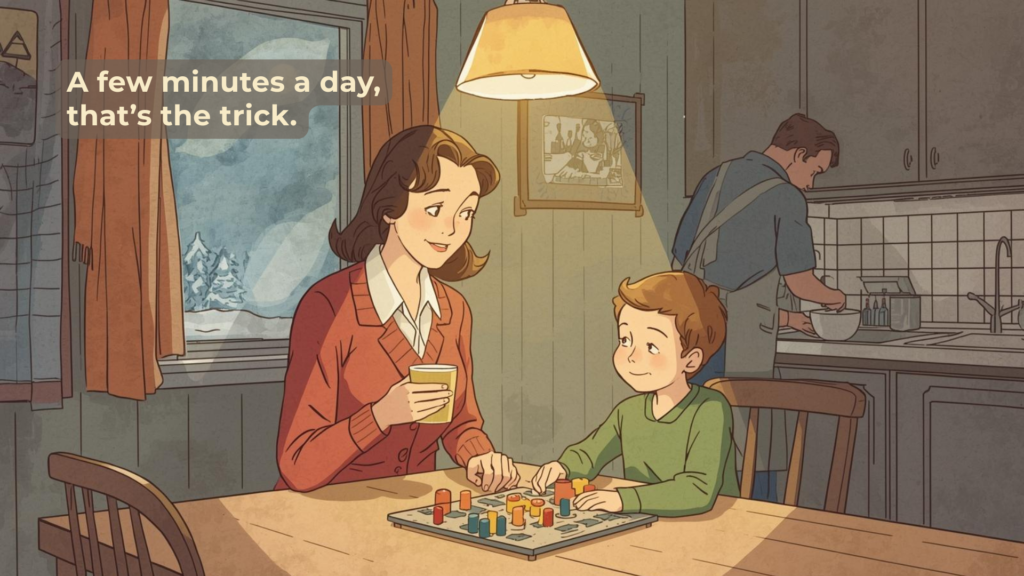
This is why some toys look “educational” but build nothing beyond novelty, while some simple games quietly build deep capability. A cardboard box can build creativity. A well-designed board game can build strategy and emotional regulation. A construction set can build spatial reasoning and persistence. Role-play can build communication and empathy.
The point is not expensive toys. The point is skill-shaped play.
And that leads to the core idea behind this platform:
What ThePlayAdvantage is trying to do
Parents do not have time to decode global reports, labor market shifts, and toy marketing claims. You should not have to become a curriculum designer just to make better choices at home.
So the aim here is simple:
- Translate credible research (like WEF and OECD) into a small set of future-facing skills that matter.
- Help you spot what actually trains those skills in everyday life, without turning your home into a classroom.
- Recommend toys and games that earn their space by building real capability, not just keeping kids busy.
- Cut the noise. Keep the signal. No hype, no panic, no “genius kid” fantasy.
If you only remember one thing from this piece, make it this: not all play is equal. Some play is pure consumption dressed up as activity. Some play builds the muscles your child will rely on when the world changes again.
That difference is the play advantage.